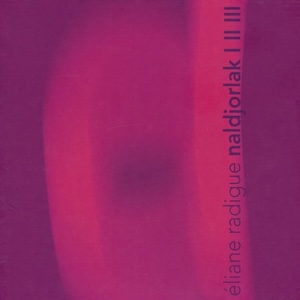
Éliane Radigue's complete Naldjorlak trilogy (2004-2009): I for cello (Charles Curtis), II for two basset horns (Carol Robinson, Bruno Martinez), III for all three. Recorded in Paris in 2011 by Daniel Deshays. 3CD.
The Naldjorlak trilogy by Éliane Radigue, composed between 2004 and 2009. Naldjorlak I for cello, Charles Curtis; Naldjorlak II for two basset horns, Carol Robinson and Bruno Martinez; Naldjorlak III for two basset horns and cello, Carol Robinson, Bruno Martinez and Charles Curtis. Recorded in Paris, June and September 2011 by Daniel Deshays. The recording of Naldjorlak I is different from the first one issued by the label.
'There is no score of Naldjorlak and never will be. It was a mutual friend of Charles Curtis and Éliane Radigue who gave her the idea of composing a piece for cello. The work came into being, little by little, during sessions between the composer and the instrumentalist. Radigue speaks of choosing from among sounds proposed by the musicians, whereas Charles Curtis explains having learned to listen like Radigue, that she led him 'to be sensitive to sonic details that normally pass by us, unnoticed'. When seated in front of her ARP 2500, Éliane Radigue was in the position of a listener: she would listen to her own music as it unfolded beneath her fingertips. What she does today is rather similar, which explains why her music has not been radically transformed in passing it to acoustic instruments: she continues conversing with her instrumentalists in the same way she had lived for years with her 'Jules' (the French nickname for boyfriend that she gave to her synthesizer), dialoguing and listening on a one-to-one basis. I like the idea that Éliane Radigue is a composer totally unhindered by scores and thus a part of the great historical lineage of the avant-gardes. Yves Klein practised Judo as a performance art and sold 'immaterial sensitivity' at the price of gold. John Cage appreciated Zen and taught us to listen to what is found in silence. Éliane Radigue, with a perfect grasp of Tibetan thought, invites us to apprehend space and time in another way. This is perhaps the true lesson of Naldjorlak (the title, invented by the composer to approximate Tibetan, evokes the concept of union): a spirituality liberated from all mysticism and from texts (or scores) too heavy to bear. Simply learn to listen to the 'almost nothing', without having any need for a visual trace.' Thibaut de Ruyter, translated by Jeffrey Grice.
Copyright(c)2006 - 2026 Art into Life All Right Reserved.




 Facebookでシェア