Label: Zeitkratzer
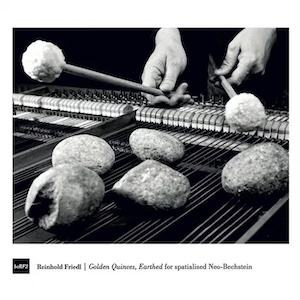
個人的激推しタイトルのストックを発見!!ケージやルシエ、ジェームス・テニーといった重鎮コンポーザーの名作リアライズから、灰野敬二氏とのコラボレーション音源数種を残しているドイツの超強者集団Zeitkratzer。このグループの創設者であり凄まじいピアノ録音を残すリーダーReinhold Friedlが2015年に残した、超傑作ソロ音源[Golden Quinces, Earthed]のストックを入荷。世界初の電気ピアノ"Neo-Bechstein"を使った凄まじい強度のエレクトロ・アコースティック録音であり、小さな木片、重い石、金属管を仕込んだプリペアド仕様にて、特殊な音響システムより厳つい爆音を放射する超傑作。
Special recording at Elektronisches Studio der Technischen Universität Berlin (TU Berlin) by Rasahd Becker to assure the spatialisation idea is documented in the stereo recording (8-track recording available for sound projection).
The Instrument
Between 1929 and 1931 the physicists Walther Nernst and his assistant Hans Driescher developed the Neo-Bechstein Grand Piano at the Heinrich Hertz Institute in Berlin. The idea was to construct an instrument for live radio transmission, because good quality microphones did not exist for this purpose. This was coincidently a difficult time for the piano industry. Piano makers tried to be modern and Bechstein even had their own department for electronic music instruments, as this seemed to be the future! The main difference to a traditional piano is that instead of amplifying the strings with the help of a wooden soundboard, they are transformed by eighteen humbucker pickups into electrical signals. These signals are sent to a valve amplifier and emitted by a mono loudspeaker. As the piano did not need a soundboard anymore, the traditional hammer mechanics had to be made differently and much lighter. A lot of sophisticated technical transformations were made. The instrument was built in co-operation with Telefunken who were responsible for the electronic devices and Bechstein who designed the mechanical parts of the instrument. No more than 150 copies of the instrument were produced and it is assumed that only a few instruments still exist, ten are now known to be in various museums. A curiosity of the instrument was the built-in radio receiver. This receiver made it possible to route both the radio signal and the instrument signal simultaneously to the output and mix them. A soundboard in a traditional piano does not only amplify the tone, it also cuts the very high frequencies and damps the oscillation of the string due to its mass. As the soundboard is missing, the Neo-Bechstein's tone oscillates about six times longer than a normal piano tone. The strings do not have any frequency cut off either. Therefore the Neo-Bechstein has a support damping mechanism in order to match the sound to a normal grand piano. Additionally, the very high frequencies are cut with a set of capacitors. Both of these construction features were removed for this project, in order to get full access to the instrument's wide sonic capabilities. As described above, the original mono output was also changed into a multi-channel output.



 Facebookでシェア